
Septic vs. Sewer in Larimer County: How to Tell Which You Have
How to tell whether a Larimer County home is on septic or sewer, who maintains what, what changes when you sell, and which areas use which.
If a city, town or sanitation district bills you for sewer or wastewater service, your Larimer County home is on public sewer; if no one does, it most likely has a septic system. To confirm, check the county’s septic records, look for tank lids or inspection ports in the yard, and read the septic paperwork from your purchase. Septic is common outside town limits, where Larimer County’s Code of the West says homes without sewer service need an approved septic system.
Call (970) 999-1365 to have the line from your house traced with a camera, whether it runs to a tank or a main.
Call nowHow to tell if you have septic or sewer
- Check who bills you. A sewer or wastewater charge from Fort Collins Utilities, Loveland Water and Power, a town or a sanitation district such as Boxelder means public sewer. If no one bills you for sewer, the house most likely has septic.
- Check county records. Larimer County’s mapping flags 14,895 parcels with septic records on file, and the Larimer County Department of Health and Environment (LCDHE), which issues septic permits, is the office to ask.
- Walk the yard. Look for tank lids or risers, and short capped pipes called inspection ports, which often sit over an open area with no trees or buildings. Lids are sometimes buried, so not seeing one proves little. Also note whether the line from the cleanout heads toward the street or into the yard.
- Read the paperwork. Purchase disclosures, a septic inspection report from the sale and county permits usually name the system.
- Trace the line. A sewer camera inspection with a locator follows the pipe from the cleanout and shows whether it ends at a tank or a main.
How septic and sewer work
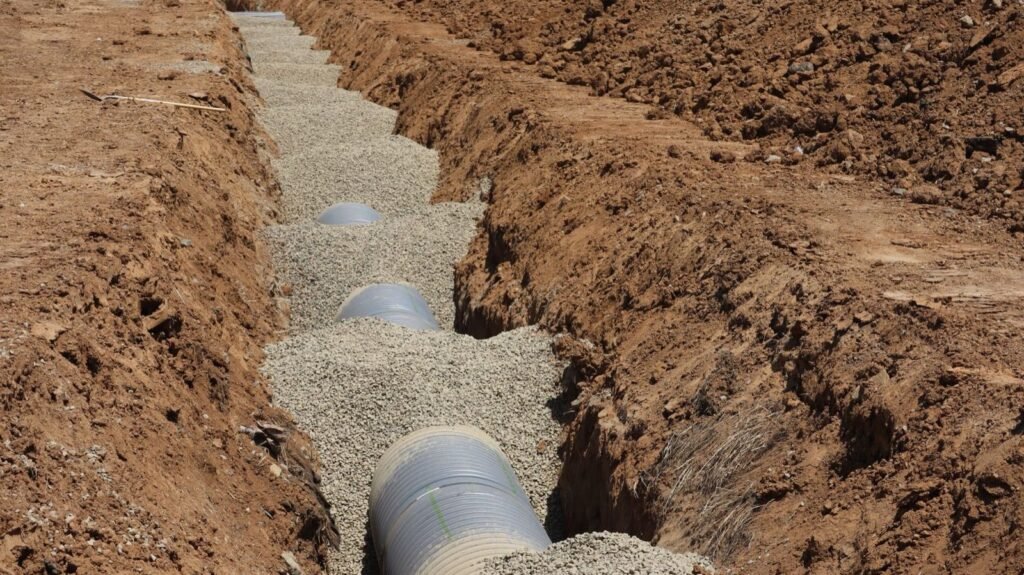
Public sewer. The pipe leaving the house, called the building sewer or lateral, carries wastewater to a public main and on to a treatment plant. The Boxelder Sanitation District, for example, maintains about 100 miles of sewer lines and treats about 1.94 million gallons a day.
Septic. The building sewer ends at your tank instead, where solids settle out. Liquid effluent flows through a second pipe to the soil treatment area (the drain field or leach field), where the soil finishes the treatment, all on your property.

Who maintains septic and sewer lines?
On sewer, you own the line to the main. Fort Collins Utilities says its customers “own and maintain sewer service pipe between the house and the sewer main (located in the street).” The city clears blockages in its main, but a blockage in your line is yours to fix. Towns and districts set their own split, which our guide to who is responsible for the sewer line compares.
On septic, the whole system is yours: the building sewer, tank, effluent line and soil treatment area. The county says, “State and county laws require you to get a permit from the Department before building or fixing a septic system.” Replacing a tank takes a Minor Repair permit, and replacing, expanding or changing the soil treatment area takes a Major Repair permit.
Septic vs. sewer at a glance
| Topic | Public sewer | Septic system |
|---|---|---|
| Where wastewater goes | Service line to a public main and treatment plant | Building sewer to your tank, then your soil treatment area |
| Who bills you | A city, town or sanitation district | No one; you pay for pumping, inspections and repairs |
| What you maintain | The service line to the main | The whole system |
| Routine upkeep | Keep grease and wipes out; clean the line when it slows | Pumping and inspection by a septic service; protect the soil treatment area |
| Permits | Town or district rules | LCDHE permits to build or fix the system |
| When you sell | No septic inspection; many buyers book a sewer scope | Certified third-party inspection, report to LCDHE before closing |
| Common line problems | Roots, sags, cracked or offset joints | The same, plus trouble at the tank inlet |
Maintenance: septic vs. sewer
Septic. The tank needs pumping and inspection on a schedule set by its size and household use, so ask your septic service how often. Keep vehicles, buildings and new trees off the tank, lines and soil treatment area, and keep grease, wipes and harsh chemicals out of the drains.
Sewer. There is no tank to pump, but grease and wipes still snag in the lateral, roots work into clay joints, and sags collect solids. A line that slows down more than once is worth a camera run.
Both. Either way, the pipe from the house fails in the same ways: roots, settling, crushing and age. About 31.9% of Larimer County homes were built before 1980 (U.S. Census Bureau, ACS 2020-2024), old enough that some still have original clay or Orangeburg fiber lines.
Buying or selling a home on septic or sewer
Selling with septic. Larimer County rules say, “If a property has an on-site wastewater treatment system, it must be inspected by a certified third-party inspector,” and the report goes to LCDHE before closing. Exemptions include systems with final approval less than three years ago and some family, estate and foreclosure transfers. An Agreement to Repair allows needed repairs “within 180 days after closing.”
Buying with septic. Ask the inspector what the report covered. To see the pipe from the house to the tank on video too, book a camera inspection.
Buying or selling with sewer. A standard home inspection usually does not look inside the sewer line, so book a sewer scope inspection during the inspection period. The video gives you something concrete to negotiate with.
Connecting to sewer when it becomes available
Septic is the fallback where public sewer does not reach. In the words of Larimer County’s Code of the West, “If sewer service is not available, you will need to use an approved septic system or other treatment process.” When a city or district main comes within reach, ask that provider whether and how you can connect and what fees apply, and ask LCDHE what it requires for the old tank.
The job usually means a new sewer service line to the main or a district connection point, with the provider’s permits and inspections. A camera run shows whether the house end of the existing line can be reused. Fort Collins Sewer Line Repair installs the new line, pulls the permits, requests the 811 locates and schedules the inspections; pumping and closing the old tank are separate septic services.
Which parts of Larimer County are on septic or sewer?
Your bill settles it, but public records give a good picture (counts “within a mile” are measured from each community’s USGS map point):
- LaPorte: mixed. Fort Collins Utilities provides wastewater service to “parts of the community of Laporte” (Utilities’ Design Criteria Manual, effective May 1, 2026). Septic is still in use: 264 parcels inside the Laporte census-designated place have county septic records, out of 1,186 tax parcels that touch it. More on LaPorte.
- Bellvue: largely septic. No sanitation district covers Bellvue, and no public sewer provider was found. Within a mile, 109 parcels have septic records, against 308 address points.
- Masonville: largely septic. No sanitation district covers Masonville either. Within a mile, 111 parcels have septic records, against 170 address points.
- Campion: mixed. No sanitation district covers Campion, but 566 of the 1,136 address points within a mile are inside Loveland or Berthoud town limits, and 58 parcels have septic records.
- Boxelder Sanitation District areas. Boxelder serves portions of Fort Collins, Windsor, Severance, Timnath and unincorporated Larimer and Weld counties.
See unincorporated Larimer County for rural water and sewer providers.
Wells, septic and why line leaks matter
Many rural homes pair septic with a private well. State permit records show 51 built domestic or household wells within a mile of LaPorte (median depth 22 feet), 59 near Bellvue (median 65 feet), 55 near Masonville (median 300 feet) and 19 near Campion. Masonville is inside Little Thompson Water District’s boundary yet still has those wells, so a district boundary does not prove a main reaches every lot. The Code of the West warns that “Permits for wells are granted by the state engineer and the cost for drilling and pumping can be considerable.”
A cracked building sewer, on septic or sewer, leaks untreated wastewater into the soil. Near a well, especially a shallow one, fix it quickly. Our septic line repair page covers the line from the house to the tank, and sewer line repair in Fort Collins covers lines to a public main.
Septic vs. sewer FAQ
How can I tell if my house is on septic or sewer?
Check who bills you: a sewer or wastewater charge from a city, town or sanitation district means public sewer. If no one does, look for county septic records, tank lids or inspection ports, and septic paperwork from your purchase.
Who is responsible for a septic system in Larimer County?
The owner, for the whole system: the line from the house, the tank, the effluent line and the soil treatment area. LCDHE issues the permits required before building or fixing one.
Do I need a septic inspection to sell my house in Larimer County?
Yes, unless the transfer is exempt. A certified third-party inspector must inspect the system, and the report goes to LCDHE before closing.
Is LaPorte on sewer or septic?
Both. Fort Collins Utilities provides wastewater service to parts of LaPorte, while 264 parcels inside the Laporte census-designated place have county septic records.
Can I switch from septic to sewer?
Only if a public sewer main is within reach and its city or district allows the connection. Ask the provider about rules and fees, ask LCDHE what it requires for the old tank, and have the new service line installed under the provider’s permit.
Am I responsible for my sewer line if I’m on public sewer?
Usually, yes, from the house to the main. Fort Collins Utilities customers own and maintain the sewer service pipe between the house and the main in the street.
Keep reading
Related guides
Frozen Water Line? How Deep Lines Are Buried in Northern Colorado and How to Thaw Them Safely
Thaw a frozen pipe safely: open the faucet, use gentle heat, never a flame. Plus burial depths, the frost line and when to call for help.
Read guide
Does Homeowners Insurance Cover Sewer Line Replacement or a Sewer Backup?
Usually not for a worn-out pipe. What standard policies exclude, what water backup and service line endorsements cover, and how to support a claim.
Read guide
How to Clear a Main Sewer Line Clog (and When to Call a Pro)
Signs the clog is in your main sewer line, how to open the cleanout and snake it safely, what not to pour down it, and when to call a pro.
Read guideSewer or water line trouble?
Call for a camera inspection of the line from your house, whether it runs to a tank or a main.
Camera inspection first, written and itemized quotes, and trenchless options where they fit.

Sewer and water line repair for Fort Collins, Loveland and Larimer County. Camera inspection first, written and itemized quotes, licensed sewer technicians.
Call (970) 999-1365